Sheep Souls and the Sense of Smell
Three Bags FullSheep Souls and the Sense of Smell is the flock’s distinctive account of what a soul is and how the living might recognize it. In this account, smell is not an incidental sense but a condition of knowing: it gives sheep access to character, danger, and presence, and provides their measure for imagining what human beings may lack. The belief shapes their talk of ghosts and later informs their attempt to make human investigators recognize a murderer.
Soul, Nose, and the Ghost
When a nameless lamb asks whether George Glenn’s ghost will return, Cloud comforts him with a categorical answer: human beings have no souls, and therefore no ghosts. Mopple the Whale objects that the sheep cannot know whether humans have souls at all. Maude supplies the flock’s underlying principle: every lamb knows that a soul is located in the sense of smell, while human beings have poor noses. Othello draws the conclusion toward reassurance, suggesting that any human ghost would be very small and harmless.
The lamb’s report complicates this tidy reasoning. He says he had already seen a large, shaggy figure dancing, which he first took for a wolf’s ghost and then identified as George’s after learning George was dead. Miss Maple immediately asks how he knew George had died by the time of the sighting. The exchange leaves the apparition unexplained, while showing how the flock tests a supernatural claim against its own sensory theory: the lamb’s keen nose seems to promise knowledge, but the timing of what he knew becomes a question in its own right.
Smell as Evidence and Access
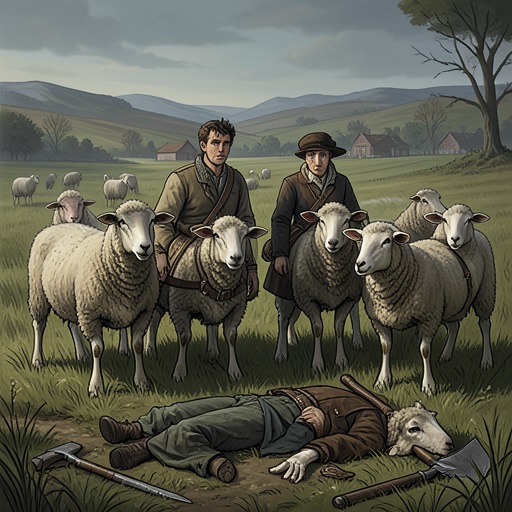
The opening discovery of George’s body establishes how bodily and immediate the flock’s knowledge can be. Miss Maple circles the body, inspects the spade, and sniffs George’s clothes and face; she even puts her nose into the wound before returning with blood on her muzzle. The sheep’s investigation proceeds through contact and smell, not through a human account of what has happened.
Mopple’s encounter with the fallen spade shows how scent can distinguish an object’s present condition from its history. At first the tool smells unusually clean, like a wet pebble, with only a faint trace of human scent. Concentrating, he recovers a more particular trail: soapy water, whiskey, vinegary cleaning fluid, a short rancid beard, and unwashed feet. The scent then ceases to belong merely to the spade; a person is moving beside him in the mist. His nose detects a human presence before his eyes can make sense of the white shadow, and fear sends him running.
The same dependence on scent marks a boundary between sheep and humans. Watching Beth and Rebecca through a window, Miss Maple can see and hear them but cannot smell them. Without that access, she feels cut off from the means by which she would judge what they feel or fear. She imagines this scentless condition as the human world: incomplete and haunted by distrust, uncertainty, and anxiety. The passage makes sensory difference consequential rather than decorative; what sheep take as a basis for confidence is precisely what they believe human beings are missing.
From Sheep Senses to Human Recognition
The flock’s theory does not remain private speculation. In planning their reenactment of George’s death, Mopple argues that humans must be able to detect some scent because they have noses, even if those noses are poor. The sheep therefore set out to make Beth recognizable by smell as well as by a visible object.
Maude finds a faint, sour smell on a rag in the toolshed. To strengthen it, the sheep bury the rag overnight, cover it with chewed sorrel the next day, and wrap it around a recently dead shrew Heather has found. Sir Ritchfield takes on the work of chewing the sorrel. The result does not exactly match Beth’s scent, but the sheep judge the resemblance sufficient for their own identification and hope it will work on human spectators too. Their method translates a sheep’s way of knowing into an attempted human proof, while exposing the gap between the flock’s confidence in scent and its uncertainty about what human noses can actually perceive.
The rag is paired with a chain and glittering pendant like Beth’s. Because the chain disappears into Miss Maple’s thick fleece when placed around her neck, she carries the small cross in her teeth instead, while Mopple follows with the pungent rag. The staged evidence thus joins scent to sight: a smell the flock has laboriously constructed and an object the audience can see. Across the novel’s account of souls, ghosts, and investigation, smell remains both a source of the sheep’s independent knowledge and the difficult bridge by which they try to make that knowledge legible to humans.